Talent in Motion: Interstate Migration of College-Educated Workers




Summary
Because highly educated workers are an essential part of sustaining economic vitality and growth, states are seeking to increase the supply of such workers. They differ, however, in the extent to which they rely on their own high schools and universities to build college-educated talent pools versus attracting talent from out of state.
Produced in collaboration with the W.E. Upjohn Institute for Employment Research, this report investigates interstate migration patterns of working-age adults with a bachelor’s or graduate degree and examines how these patterns differ by state, type of institution attended, level of educational attainment, major, occupation, and worker characteristics. We pay particular attention to homegrown talent, or talent that graduated from high school and college in the same state where they now live.
To date, there has been little information available to help states understand and respond to the migration patterns of graduates. This study provides insights that can help policymakers characterize the sources of their college-educated workforces, examine the factors associated with interstate migration, and invest strategically to grow the talent their states need. These findings also may be informative for employers seeking to understand their talent pipelines and students making decisions about their education, careers, and life goals.

Key findings
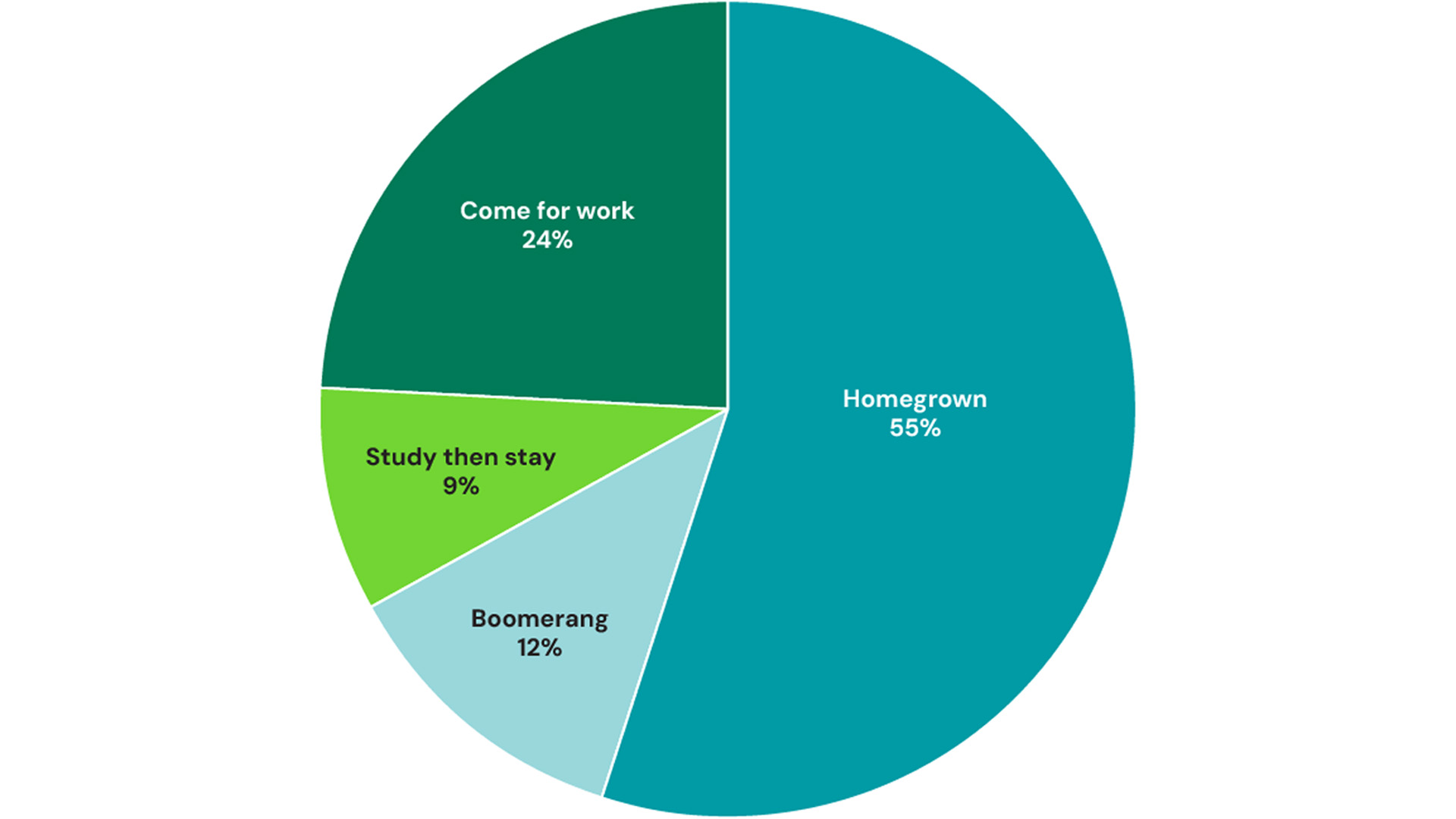
Most attended college and now work there (55 percent), while a smaller share returned to their home state to work after attending college elsewhere (12 percent).
Among individuals younger than age 50, the percentage is even greater — around 55 percent. However, only 33 percent of individuals ages 50 years and older reported economic opportunity as their primary motivation, with an additional 23 percent reporting housing or community and 23 percent reporting family.
For instance, 72 percent of college-educated workers in Michigan stayed in their home state for college and work, but 36 percent of college-educated workers in Colorado did so.
For instance, Oklahoma, Alabama, Louisiana, and Arkansas have above-average shares of homegrown talent but below-average college attainment; there are exceptions, however, such as New York with above-average homegrown talent and above-average college attainment.
This finding reflects the important role played by states’ public higher education institutions in building their college-educated workforces.
About two-thirds of graduates of public institutions with broad-access admissions, and half of graduates of the most selective public institutions, attended college and now work in their home state.
Highlights
Fifty-five percent of the college-educated workforce nationwide is homegrown — individuals who live and work in the state in which they completed both high school and college. Another 12 percent are workers who graduated from high school, left to attend college elsewhere, but then returned to their home state after college.
Taken together, two-thirds of a state’s college-educated workforce, on average, graduated from the state’s own high schools, while about one-third of college-educated talent migrated to the state at some point after high school.
Figure 3:
The largest share of college-educated talent is homegrown, working in the same state where they attended high school and college
Source: Strada-Gallup Survey.
Notes: The sample includes respondents 20–65 years of age who are in the workforce, who hold a bachelor’s degree or graduate degree, and who reported the state(s) in which their high school and most recent college are located, as well as the state of their current residence; n=15,785.
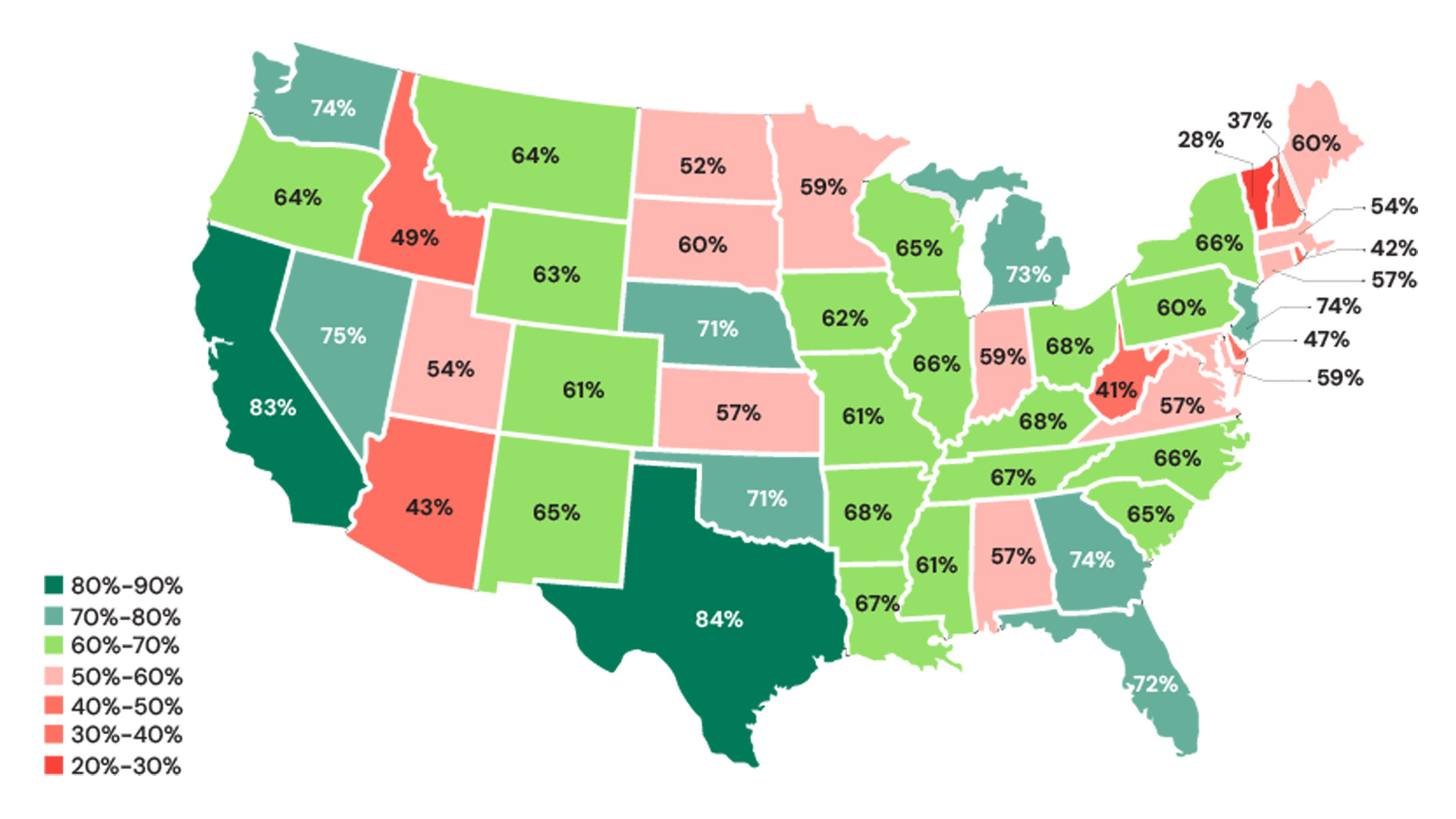
On average, about 66 percent of college-educated talent remains in the state where they completed college, but the percentage varies across states.
Figure 10:
The retention of college-educated talent produced by in-state colleges differs appreciably across states
Source: Strada-Gallup Survey.
Notes: For each state, the map reports the percentage of college-educated talent retained in state. The sample includes respondents who hold a bachelor’s degree or graduate degree, graduated between 2010 and 2019, and about whom we know the state of their most recent college and the state of their current residence; n=28,236.
Recommendations
Developing, attracting, and retaining a skilled workforce is a perennial challenge for state, regional, and local policymakers, and an aging population will make this challenge even more urgent in the years ahead. To build and support a skilled workforce now and in the years ahead, policymakers should consider the following recommendations:
Continue to gain a deeper understanding of the motivations for migration in your state.
While our analysis characterizes many of the broad contours and patterns of talent migration, a number of differences remain unexplored. Additional in-depth and context-specific analyses of migration patterns would aid state and local governments’ efforts to predict and build their future talent pool.
Strengthen high-impact investments in public postsecondary education to meet workforce needs.
Despite interest in attracting talent from other states, most states face long odds of doing so as homegrown talent is the primary source of college-educated workers in most states.
Facilitate statewide economic opportunities across all career stages.
States with high retention of in-state college graduates also tend to have favorable economic conditions for college-educated workers, including higher college wage premiums, robust employment growth, and lower income tax rates.




.jpg)





.jpg)


.avif)